
Enterprise Virtualization &
Cloud Architecture
A strategic approach to designing, migrating, and optimizing virtualized and cloud-ready enterprise environments for agility, scalability, resilience, and operational efficiency.
VMware
Proxmox
Cloud Readiness
Workload Migration
01.
ASSESS
Current-state review, workload analysis, and virtualization readiness.
02.
ARCHITECT
Target platform design for compute, storage, networking, and cloud integration.
03.
MIGRATE
Controlled workload migration with minimal business disruption.
04.
OPTIMIZE
Performance tuning, resilience, governance, and lifecycle improvement.
Overview
Enterprise virtualization and cloud architecture provide a flexible, efficient, and resilient foundation for modern IT, enabling organizations to run critical workloads with greater agility and control.
By combining proven virtualization platforms with cloud-ready design, businesses can optimize resource utilization, reduce operational complexity, and scale infrastructure to meet evolving demands.
Key Focus Areas
Virtualization assessment & platform planning
VM consolidation & workload optimization
High availability & cluster design
Hybrid cloud readiness & integration
Backup, recovery & business continuity
Monitoring, governance & security
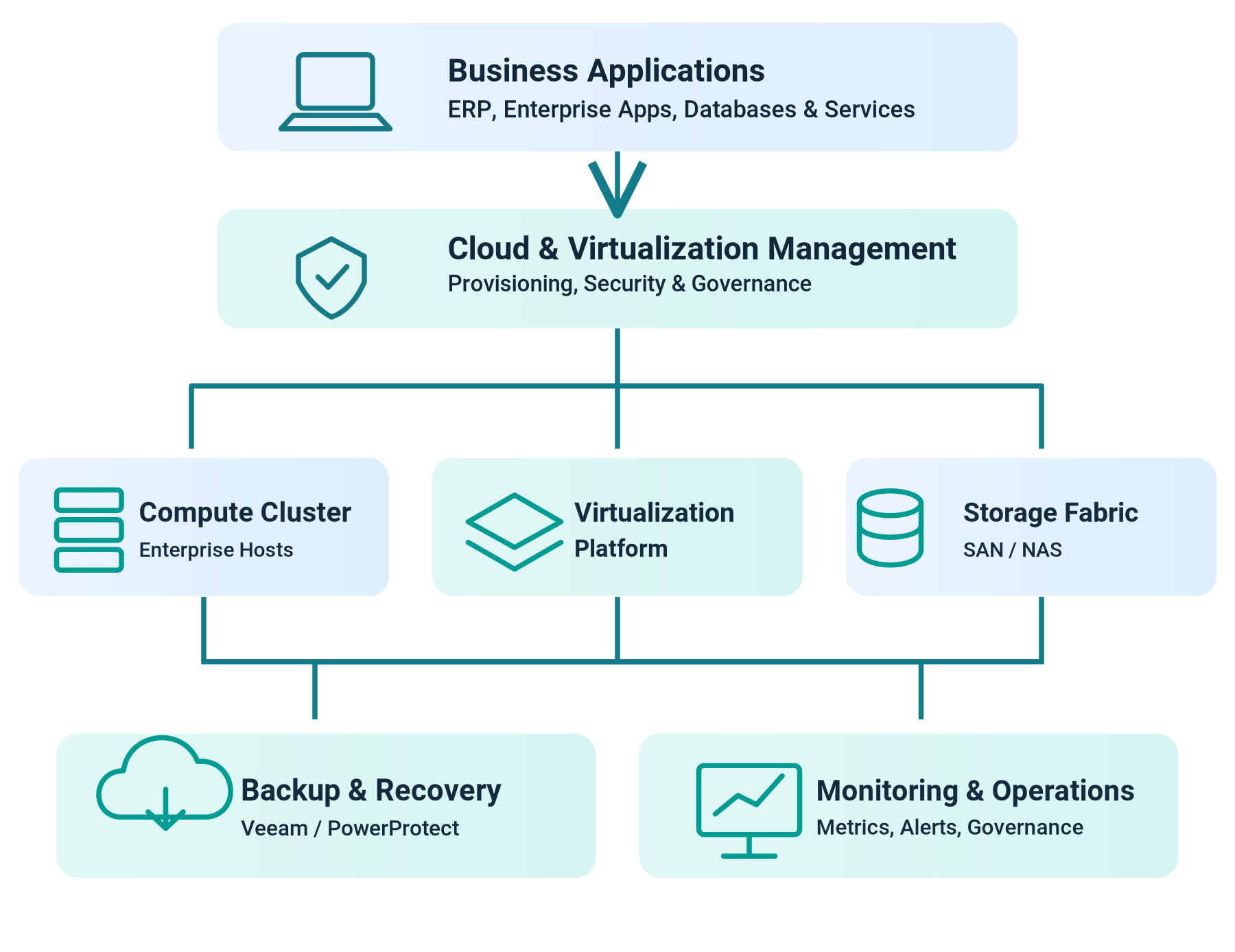
Reference Architecture
Implementation Methodology
A structured, low-risk approach to design, build, and migrate a modern virtualized and cloud-ready environment.
01
Discovery
Capture requirements and analyze the current environment.
02
Design
Define target architecture and platform strategy.
03
Planning
Create a detailed migration and implementation plan.
04
Build
Deploy and configure virtualized and cloud components.
05
Migration
Migrate workloads in a controlled, phased manner.
06
Validation
Verify performance, resilience, and operational readiness.
07
Handover
Transfer knowledge, document the solution, and provide support.
Technology Platforms
Engineering Principles
Reliability
Ensure high availability and service continuity.
Security
Protect workloads and data with layered controls.
Scalability
Design for growth and on-demand capacity.
Manageability
Enable efficient operations with centralized visibility.
Virtualization & Cloud Infrastructure for Organizations in Nepal
As a virtualization consultant in Nepal, I help organizations assess, design, and modernize enterprise infrastructure using VMware, Proxmox, and cloud-ready technologies. For organizations in Kathmandu Valley and elsewhere in Nepal, a virtualization strategy needs to account for more than hypervisor features. Workload criticality, electrical resilience, connectivity, hardware lifecycle, licensing, local operational skills, and achievable recovery objectives all influence the target design.
My consulting approach begins with business requirements and existing infrastructure, then evaluates whether an on-premises cluster, hybrid-cloud architecture, or phased workload migration is a practical fit. The goal is an environment that the organization can operate, secure, recover, and scale—not simply one with more virtual machines.
Server Consolidation
Assess aging physical servers, application dependencies, CPU and memory headroom, and realistic capacity growth before consolidating workloads.
Resilience & Continuity
Design for power and connectivity disruption, remove avoidable single points of failure, and validate restoration procedures against defined RTO and RPO.
Cloud-Ready Architecture
Evaluate the benefits and constraints of keeping workloads on-premises, using cloud services, or adopting hybrid deployment.
ARCHITECTURE CONSIDERATIONS
Technical Decisions Behind a Reliable Virtualization Platform
A sound design balances resilience, performance, cost, security, and the team’s ability to operate the environment.
01 / Hypervisor & Workload Fit
Virtualization platform selection should reflect supported guest operating systems, application vendor requirements, cluster features, subscription and support costs, existing skills, and the organization’s change-management process. VMware and Proxmox should be compared against those criteria—not chosen on licensing cost alone.
02 / Compute, Storage & Network Design
Cluster sizing should consider failure headroom, memory reservations, CPU contention, storage latency, network throughput, management segmentation, and growth. Shared storage, hyperconverged storage, or local storage may each be appropriate for different availability and operational requirements.
03 / Security, Backup & Recovery
Harden hypervisor and management access, separate tenant or workload networks where necessary, apply least privilege, and monitor configuration changes. Virtualization high availability does not replace independent backups, off-site recovery copies, or restoration testing.
04 / Migration & Operational Readiness
A migration plan should document application dependencies, compatibility, maintenance windows, data consistency checks, rollback steps, acceptance criteria, and ownership after handover. Phased cutovers and restore tests reduce risk, although downtime requirements must be assessed per workload.
PRACTICAL QUESTIONS
Virtualization & Cloud Architecture: Common Questions
Should a Nepalese business choose VMware or Proxmox?
There is no universal answer. Assess application support, availability features, required integrations, security controls, licensing and subscription costs, vendor or community support, and internal expertise. A pilot with representative workloads is more useful than choosing solely on price.
Can physical servers be migrated to virtual machines without downtime?
Some workloads can be migrated with very short interruptions, while others require scheduled downtime or application-specific replication. A reliable plan includes dependency mapping, data validation, a tested rollback path, and a maintenance window agreed with the business.
Does a highly available virtualization cluster eliminate the need for disaster recovery?
No. High availability may help restart workloads after some host failures, but it does not replace verified backups, protection against data corruption or ransomware, off-site recovery options, and tested restoration procedures. RPO and RTO must be defined for each critical service.
What should be evaluated before moving Nepal-hosted workloads to hybrid cloud?
Review connectivity and latency, workload dependencies, data protection, access controls, service costs, operational support, and any applicable data-handling obligations. Keep critical workloads where the combination of performance, security, recoverability, and cost is most suitable.
About This Technical Portfolio
Prepared for sym.com.np by Er. Shyam Siwakoti, an IT Consultant with experience across enterprise infrastructure, virtualization, security, and IT operations. This page explains an engineering approach and reference architecture; it is not presented as a measured result from one named customer engagement.
Related reading: Enterprise Data Center Modernization.
Discuss Your Infrastructure
Considering server consolidation, a VMware or Proxmox deployment, workload migration, or hybrid-cloud planning in Nepal?